

Most businesses do not realise how much time they spend looking for information until finding a document becomes a problem.
A contract is needed for a meeting, but nobody remembers where it was saved. An old invoice is buried somewhere in a shared folder. A team member has the latest version of a proposal, while someone else is still working on an older copy. A document that was easy to find six months ago suddenly seems to have disappeared.
These may sound like small workplace frustrations, but they add up. As businesses grow, so does the amount of information they create and receive. Contracts, invoices, reports, policies, employee records, presentations, forms, project documents, emails and other files quickly become difficult to manage when they are scattered across different locations.
This is where document management becomes more than simply storing files. It becomes about making information easier to organise, find, access and use.
Why Managing Documents Has Become More Difficult
There was a time when businesses could keep most of their important paperwork in filing cabinets and folders. Today, documents are increasingly digital, but that does not necessarily mean they are easier to manage.
In fact, digital information can create its own problems.
Files may be stored on individual computers, shared drives, cloud folders, email accounts or different applications used by different departments. Employees may also create multiple copies of the same document, often with names such as "final," "final-new," or "final-updated." It is surprisingly easy for a team to lose track of which version is actually the correct one.
The problem becomes even more noticeable as a company grows. More employees mean more documents, more collaboration and more information moving between teams.
Without a sensible system in place, finding the right document can become a task in itself.
Document Management Is About More Than Storage
It is easy to think of document management as another way of saying "file storage." But the two are not quite the same.
Storage answers a basic question: where are the files kept?
Document management goes further. It deals with how those files are organised, searched, accessed, updated and handled throughout their lifecycle.
For example, imagine an employee needs to locate a particular client agreement from two years ago. In a basic storage system, they may have to remember the folder where it was saved and search through several files manually.
A well-organised document management system can make the process much more straightforward. Instead of remembering exactly where the file was stored, users can search for relevant information and locate the document they need.
That difference can have a real impact on productivity.
The Hidden Cost of Searching for Information
Employees spend a surprising amount of their working day looking for information.
Sometimes the problem is not that a document does not exist. It is simply that nobody knows where it is.
Someone may have to ask a colleague, search through email attachments, check different folders or recreate a document because the original cannot be located quickly. When this happens repeatedly across a team, the lost time becomes significant.
There is also a less obvious cost: interruption.
Every time an employee stops their work to search for a file or ask someone else for information, their attention is pulled away from the task they were doing. A five-minute search can easily turn into a longer interruption when the required document is not immediately available.
This is one reason businesses are increasingly looking at Document management software in India as part of their broader digital workplace strategy. The objective is not simply to replace paper files with digital ones. It is to make business information easier to work with.
Search Has Become a Business Requirement
As the amount of information grows, search becomes increasingly important.
Traditional file systems often depend on users knowing where something has been stored. That works reasonably well when there are a few folders and a limited number of documents. It becomes much less practical when thousands of files are spread across departments.
A modern document management approach can make information more discoverable. Instead of relying entirely on folder structures and filenames, users can search using relevant terms and retrieve information from a larger pool of business documents.
This becomes particularly useful when employees need to find information they did not create themselves.
A new employee, for example, may not know how a company's folders are organised. An employee who has moved to another department may not know where older project documents were kept. Search can reduce that dependence on institutional memory.
Why Businesses Are Looking Towards AI
Artificial intelligence is changing the way people interact with information, and document management is one area where that change is particularly noticeable.
Traditional systems generally require users to search using filenames, folders or carefully chosen keywords. AI can introduce a more natural way of working with documents.
Instead of simply asking, "Where is this file?", users may want to ask a question about the information contained within their documents.
For example, a finance team might want to locate agreements containing a particular payment condition. A legal team may need to find documents referring to a specific clause. A project team might want to identify documents relating to a particular client or requirement.
This is where AI document management software in India can offer a different approach to handling business information. AI can help businesses move from simply storing documents to extracting useful information from them.
The technology does not eliminate the need for organised information. Rather, it can make the information businesses already possess easier to access and work with.
Security and Access Matter Too
Convenience should not come at the cost of control.
Business documents can contain confidential client information, financial records, internal policies, contracts and other sensitive material. A document management system therefore needs to consider not only how information is found, but also who can access it.
Different employees may have different responsibilities, and not everyone necessarily needs access to every document.
Businesses should therefore consider access controls, permissions, document handling practices and other security-related capabilities when evaluating a document management solution.
A system that combines accessibility with appropriate control can help organisations make information available to the people who need it without treating every document as universally accessible.
Choosing the Right Document Management Approach
There is no single solution that will suit every organisation.
A small business may primarily need an easier way to organise and retrieve documents. A larger organisation may have more complex requirements involving multiple departments, large document volumes, access controls and information discovery.
When evaluating the Best document management software in India, businesses should therefore look beyond the number of features advertised.
The more useful questions are practical ones. Can employees find information without extensive training? Can the system handle the organisation's growing volume of documents? Does it reduce dependence on manual searching? Can users work with different types of documents? Can the organisation maintain appropriate control over its information?
The answers to these questions are likely to matter far more in everyday use than a long feature list.
Turning Business Documents into Usable Information
The real opportunity in document management is not simply having fewer folders.
It is being able to make better use of the information those documents contain.
Businesses accumulate knowledge over years. Contracts reveal commercial terms. Reports contain operational insights. Project documents record decisions. Policies capture organisational processes. Customer documents provide context that may be useful long after a particular interaction has ended.
When this information is difficult to find, much of its potential remains unused.
Better document management can help bring that information closer to the people who need it. With AI becoming part of this process, the relationship between businesses and their documents is also changing. Instead of treating files as static objects that need to be stored, organisations can increasingly treat their document repositories as sources of usable knowledge.
Intellodocs by Imbibe Tech
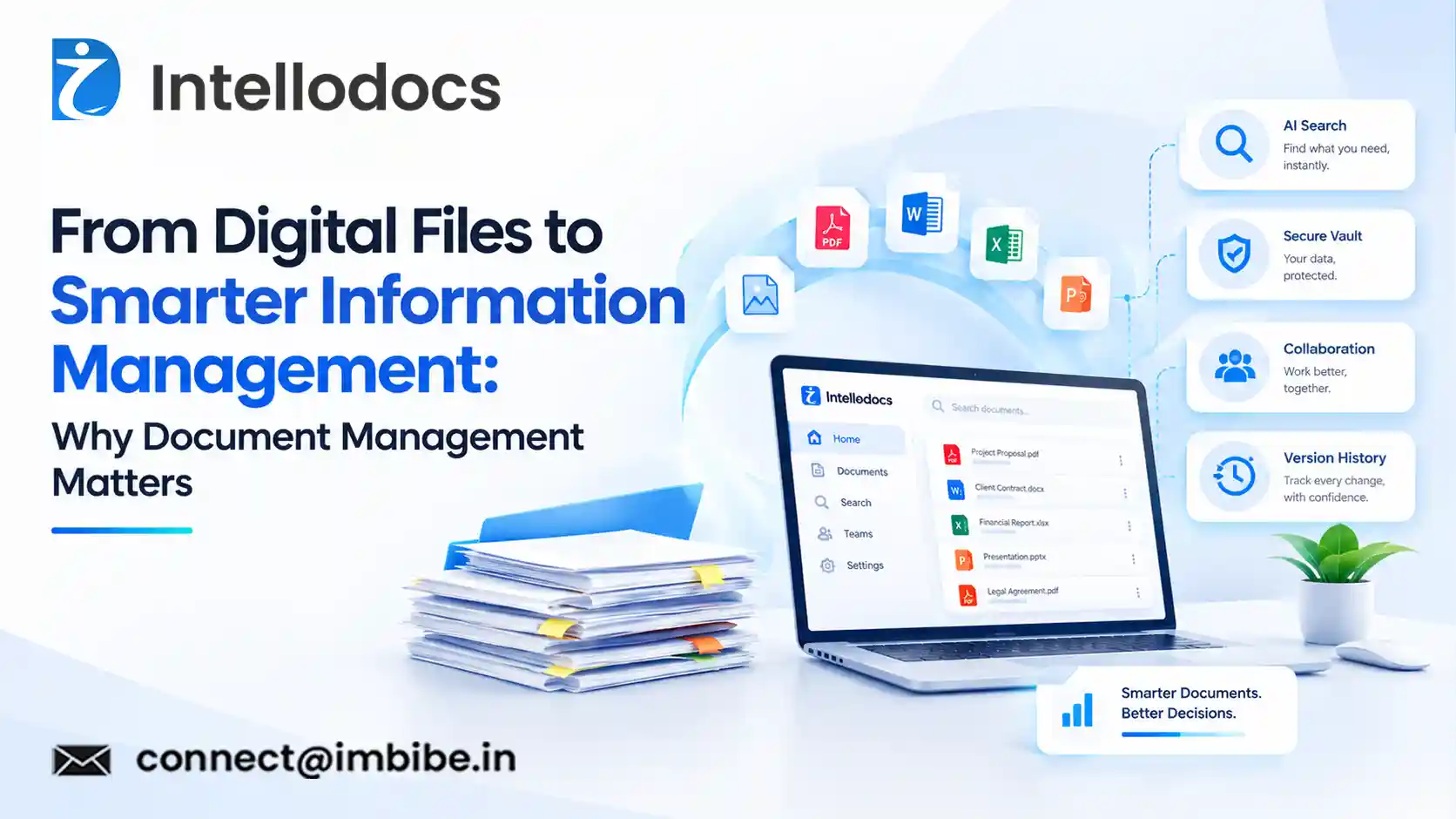
Intellodocs by Imbibe Tech is designed to make business documents easier to manage, search and work with. Its AI-powered approach focuses on helping users discover information within their documents rather than relying solely on traditional folder-based storage. By bringing document management and intelligent information discovery together, Intellodocs aims to help businesses spend less time searching for files and more time using the information those files contain. For organisations dealing with growing volumes of business documentation this approach can provide a more practical way to bring scattered information into a searchable and usable environment.
Ultimately, the value of document management is not measured by how many files a business can store. It is measured by how easily people can find the right information when they need it.
As businesses continue to generate more digital content, simply adding more folders is unlikely to solve the problem. What matters is creating an environment where information remains accessible, organised and useful. And with AI becoming increasingly capable of understanding documents and the information within them, the future of document management is moving steadily from storing information towards making sense of it.