

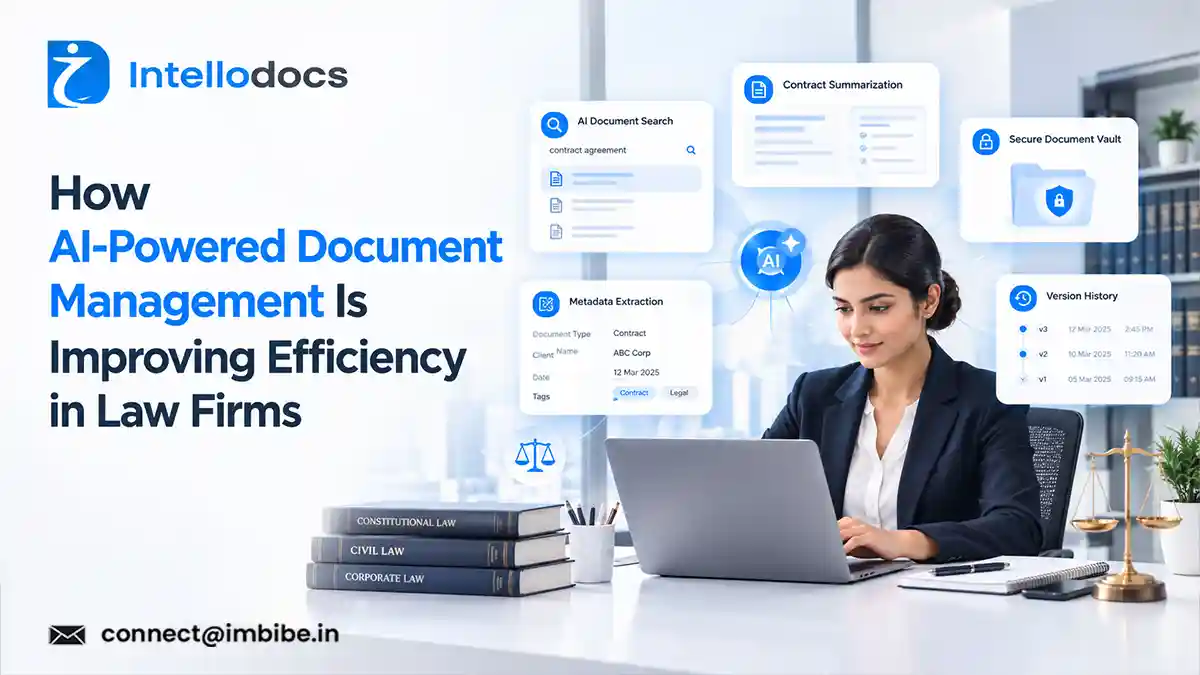
Legal work is built around information. A single matter may involve contracts, correspondence, affidavits, court orders, evidence, notices, research documents and several rounds of revised drafts. Each record may contain information that becomes important at a particular stage of the matter, sometimes months or years after the document was first created.
For lawyers, finding the right document is not merely an administrative task. It can influence how quickly a client receives an update, how efficiently a case is prepared and how confidently a legal team can verify the facts. Yet, many firms continue to manage substantial volumes of paperwork through a combination of shared folders, email attachments, messaging applications and manually maintained registers.
As legal practices become more digital, the challenge is shifting from storing documents to making the information within them accessible, organised and secure. This is where intelligent document management can make a meaningful difference.
Why Legal Document Management Is More Complex Than File Storage
A legal document rarely exists in isolation. An agreement may be followed by amendments, correspondence, notices and supporting records. A litigation matter may generate pleadings, affidavits, exhibits, interim orders and final judgments. Each document must remain associated with the correct client and matter, while its status and relevance may change as the work progresses.
Traditional folder structures depend heavily on employees following consistent naming conventions and filing procedures. When documents arrive from several sources, this consistency can be difficult to maintain. A contract might be saved under a client's name, attached to an email or stored in a folder belonging to the associate who handled the transaction.
Finding the document later may require searching multiple locations and opening several files. The problem becomes more pronounced when a firm handles many active matters or when employees need access to records created by colleagues who are no longer involved in the engagement.
Effective Document management software in India can help legal practices establish a centralised, structured approach to managing records. However, the real advantage comes when the system makes document contents searchable and helps users identify the information they need without depending entirely on filenames.
From Scanned Paperwork to Searchable Legal Information
Many legal records still originate as scanned documents, photographs or PDFs that contain images rather than searchable text. Although these files can be opened and read by a person, a conventional search tool may not be able to identify words appearing within them.
Optical character recognition, or OCR, addresses this problem by converting text in scanned pages and images into machine-readable information. Once processed, a document can become searchable by its contents, subject to the quality of the scan and the accuracy of recognition.
Artificial intelligence can build on this foundation by helping classify documents and identify relevant information. A system may recognise that a file is a contract, affidavit, notice or court order. It may also extract details such as parties' names, dates, reference numbers and other fields where those details are available.
This information is often described as metadata. In practical terms, metadata provides useful details about a document, helping users organise and retrieve records without having to remember how each file was originally named.
For example, an associate looking for a signed agreement from a particular period could search using the client, date or document category. An AI-enabled system with natural-language search may also allow a user to describe what they are looking for in ordinary language.
Such capabilities do not guarantee that every document will be recognised perfectly. Unclear scans, handwritten notes and complex layouts may affect extraction accuracy. Important information must therefore be checked against the original record.
How Natural-Language Search Can Help Lawyers
Legal professionals often remember the substance of a document without remembering its exact filename. A lawyer may recall that a contract contained a particular termination provision or that a client submitted correspondence concerning a specific obligation. Searching by a generic filename may not be enough to find the relevant information.
Semantic search helps address this problem by interpreting the meaning and context of a query. Instead of looking only for an exact sequence of words, it can identify documents that appear relevant to the user's intended question.
For example, a lawyer might search for agreements containing a termination clause or ask for documents associated with a particular client matter. Depending on the system's capabilities, the results may include relevant passages as well as the documents in which they appear.
Some platforms can also generate answers based on the documents they retrieve. When those answers are linked to source passages, lawyers can inspect the original wording and determine whether it supports the response.
This is especially important in legal practice. An AI-generated summary is not a substitute for reading the relevant clause, reviewing the surrounding provisions or considering the wider legal context. The technology should help lawyers locate and examine information, not make professional decisions on their behalf.
Supporting Contract Review and Version Control
Contract drafting often involves several people and multiple rounds of revision. A document may pass from a junior associate to a senior lawyer, then to a client and eventually to another party for negotiation. Each stage can introduce changes that need to be examined carefully.
Without reliable version control, employees may accidentally work on an outdated draft or struggle to determine which provisions were changed during a particular review. A clear document history helps establish how a file evolved, while comparison tools can highlight differences between versions.
Document management systems that provide version history, check-in and check-out controls, and visual comparison can support a more disciplined drafting process. These features are useful not only for commercial contracts but also for legal notices, pleadings, opinions and other documents that undergo repeated revisions.
A structured repository also helps preserve earlier records for reference. When a client returns with a related matter, authorised team members may be able to retrieve the relevant agreement or correspondence more efficiently, provided the documents were stored and indexed correctly.
Confidentiality and Access Control in Legal Practice
Law firms handle information that may be privileged, commercially sensitive or subject to contractual and legal confidentiality obligations. A document management system must therefore be assessed for security as well as convenience.
Access permissions allow firms to determine which users can view, edit or share particular records. Document-level controls can be especially useful when different teams handle separate clients or when a matter requires restricted access. Activity logs can provide a record of document-related actions and support internal accountability.
Secure sharing is another important consideration. Sending documents as email attachments can create multiple copies outside the firm's central repository. Controlled sharing arrangements can help teams manage external access more deliberately, although the actual safeguards depend on the platform and its configuration.
Before implementing any system, a law firm should examine encryption, authentication, backup and recovery arrangements, data residency, retention policies and contractual responsibilities for protecting information. It should also establish procedures for removing access when employees leave or when an engagement ends.
AI introduces additional questions. Firms should understand how their documents are processed, whether information is used to train external models, which service providers can access the data and what safeguards apply to sensitive material. These questions should be answered through technical documentation and contractual commitments rather than assumptions.
Choosing the Best Document Management Software in India
The Best document management software in India for a law firm should support the way lawyers actually work. Centralised storage alone may not be enough if users still struggle to retrieve contracts, compare drafts or identify the source of an AI-generated answer.
Firms should test the software using realistic examples, including scanned agreements, lengthy PDFs, correspondence and documents containing similar filenames. They should evaluate search accuracy, source traceability, access controls and the ease of organising records by client and matter.
The platform should also fit the firm's existing processes. Integration with current tools, straightforward onboarding and reliable export options can be as important as advanced AI features. A system that employees find difficult to use may result in inconsistent adoption and incomplete records.
AI-assisted document management should be treated as a support mechanism rather than a replacement for legal research, verification or professional judgement. Lawyers must continue to consult authoritative legal sources, verify factual claims and examine original documents before relying on information in legal advice or court submissions.
Making Legal Information Easier to Find and Use
The growing volume of legal documentation makes efficient information retrieval an increasingly important part of practice management. Lawyers need to spend their time interpreting evidence, advising clients, preparing arguments and negotiating agreements, rather than repeatedly searching through folders for documents that already exist.
For law firms considering a more intelligent approach, Intellodocs provides an AI-powered document management platform with document capture through supported channels, AI-assisted classification, metadata extraction and natural-language search. Source-linked answers, document version history, permissions and audit logging can help legal teams organise and retrieve their records more efficiently. Firms should evaluate these capabilities against their specific requirements, with particular attention to confidentiality, security configuration and the handling of sensitive legal documents.
Ultimately, effective document management combines appropriate technology with sound professional procedures. By making records easier to locate, review and verify, law firms can reduce avoidable administrative effort, improve continuity across matters and create more time for the legal work that requires human expertise.