

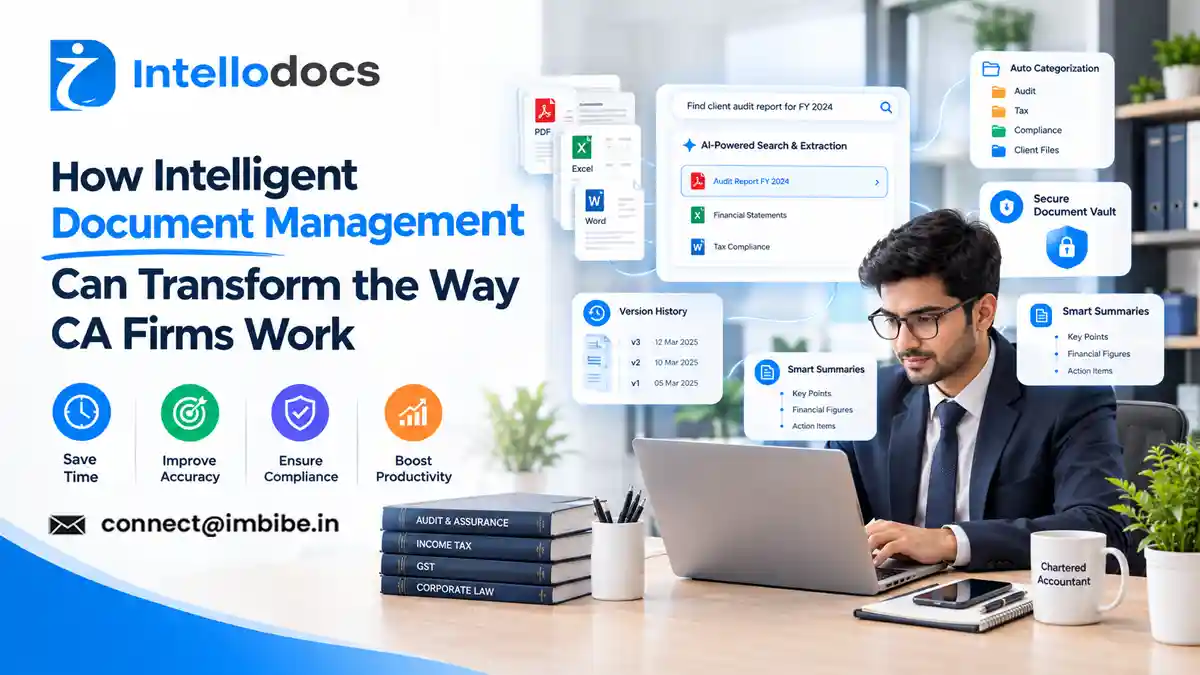
The work of a chartered accountant extends far beyond preparing financial statements and filing tax returns. Every client relationship involves a growing collection of financial records, tax documents, invoices, bank statements, audit reports, compliance certificates and supporting paperwork. Managing these documents accurately is essential to maintaining an efficient practice, yet finding the right information at the right time remains a challenge for many accounting firms.
As businesses become increasingly digital, the volume of documentation handled by CA firms continues to grow. Documents arrive through email, messaging applications, client portals and physical submissions that are later scanned and uploaded. When these records are stored across different folders and systems, retrieving a particular file can consume valuable time. This makes intelligent document management an important consideration for firms looking to improve productivity without compromising accuracy.
Why Document Management Has Become a Priority for CA Firms
A typical CA firm manages multiple clients with different financial years, filing schedules and reporting requirements. One client may require assistance with GST returns, another may need an income tax assessment reviewed, while a third may be preparing for an audit. Each engagement generates documents that must be stored, accessed and verified when required.
Traditional folder-based storage can work well when the number of documents is limited. However, as the practice expands, maintaining a consistent filing structure becomes increasingly difficult. Employees may save files using different naming conventions, create duplicate copies or store attachments locally before transferring them to a shared drive. Over time, even a well-intentioned filing system can become difficult to navigate.
Consider a situation in which a partner needs a client's bank statement from a previous financial year. The document may be stored in a folder labelled with the client's name, saved under the relevant assessment year or buried in an email conversation. Someone must locate the file, open it and confirm that it belongs to the correct period.
When this happens repeatedly across dozens or hundreds of clients, the cumulative loss of productive time becomes significant. Effective Document management software in India can help address this problem by bringing records into a more organised environment and making them easier to retrieve.
Moving Beyond Digital Filing Cabinets
Digitising paperwork is not the same as making information easily accessible. A shared drive may contain thousands of PDFs, spreadsheets and scanned images, but users still need to know where to look and which filename to search for.
Modern document management systems go beyond storage by providing indexing, categorisation, access controls and search capabilities. Artificial intelligence adds another layer by helping software understand the contents of documents instead of relying exclusively on manually entered filenames and labels.
This distinction matters because financial documents often contain information that is more useful than their titles. A bank statement may include a client's name, account period and transaction details. A tax notice may contain an assessment year, a reference number and a response deadline. When relevant details are extracted and indexed, users can locate documents using those details rather than depending entirely on the original filename.
How AI Document Management Software Works
The process begins when a document enters the system. It may be a digital PDF, a Word file, a spreadsheet or a scanned image. Depending on the platform and its supported integrations, documents can be received through email, messaging channels, direct uploads or other connected sources.
The software then processes the document to make its contents searchable. Optical character recognition, commonly known as OCR, converts text appearing in scanned pages or images into machine-readable text. This is particularly useful when clients submit photographs of receipts, older financial records or scanned certificates.
Artificial intelligence can then assist in identifying the type of document and extracting relevant information. For example, a system may recognise a GST return, an invoice, a bank statement or an audit report. It may also identify details such as names, dates, reporting periods and financial amounts where these are available and readable.
This information can be stored as metadata, which is essentially descriptive information about a document. Metadata helps the system organise records and retrieve them using relevant attributes.
The next stage is intelligent search. Instead of remembering a precise filename, an employee may be able to search for documents associated with a particular client, financial year or reporting requirement. Some AI-enabled systems also support natural-language queries, allowing users to ask questions in ordinary language.
For instance, a team member might ask, "Find the client's GST returns for the previous financial year." The system can use the meaning of the query to identify potentially relevant records. Where AI-generated answers are available, source-linked references can help the employee verify the information against the original document.
AI does not guarantee that every document will be classified correctly or every extracted value will be accurate. Poor-quality scans, handwritten entries and inconsistent formatting can affect results. Professional verification therefore remains essential, especially when financial reporting or regulatory compliance is involved.
Practical Applications Across Accounting Workflows
One of the most useful applications of intelligent document management is client record retrieval. During tax season, accountants often need to revisit previous returns, compare financial information or locate supporting documents. Faster retrieval can reduce administrative delays and make historical records more accessible during client discussions.
Audit preparation is another area where organised documentation matters. Auditors must review evidence, trace financial entries and establish whether the supporting records are appropriate. A structured repository with reliable search capabilities can make it easier to locate invoices, bank statements, contracts and other relevant records. It does not replace audit procedures, but it can reduce the effort involved in gathering documentation.
Document comparison is equally important. Accounting firms regularly handle revised financial statements, amended reports and updated working papers. When several versions circulate between preparers and reviewers, confusion can arise over which file contains the latest changes. Version history and document comparison tools help users identify revisions and establish a clearer record of document development.
Access control also deserves attention. Client records can contain sensitive financial and personal information, and not every employee needs access to every engagement. Permissions based on roles, clients or document categories can help firms limit unnecessary access. Activity logs may also help establish when a document was accessed, modified or shared.
Intelligent document management can improve continuity when employees change roles or leave the organisation. When records are stored systematically and are searchable by authorised team members, important information is less dependent on an individual employee's memory or personal filing habits.
Choosing the Best Document Management Software in India
The Best document management software in India for a CA firm should address its actual workflow rather than simply offer large amounts of storage. Firms should evaluate how easily documents can be uploaded, whether scanned records can be searched, how accurately metadata is extracted and whether results can be traced back to original sources.
Security and governance should be assessed just as carefully. Accountants need to understand how permissions are configured, where client information is stored, how backups are managed and what happens when records must be retained or deleted. Encryption, audit trails, recovery procedures and contractual data-protection commitments should form part of the evaluation.
Integration requirements are another consideration. A document management system should complement, rather than unnecessarily complicate, existing accounting, tax preparation and practice management workflows. Before adopting a platform, a firm should confirm which integrations are actually available and test the system using representative client documents.
Implementation also requires a change in working practices. Employees need clear rules for naming or identifying clients, uploading documents, reviewing AI-extracted information and maintaining consistent records. Even sophisticated technology will deliver limited benefits if documents continue to be stored outside the agreed process.
Making More Time for Professional Expertise
The purpose of intelligent document management is not simply to reduce the number of folders a firm maintains. It is to reduce the effort required to find, verify and use information. When accountants spend less time searching through files, they can devote more attention to financial analysis, identifying discrepancies, advising clients and preparing for reviews.
For firms exploring this approach, Intellodocs offers an AI-powered document management platform designed to help capture documents from supported channels, classify records, extract metadata and retrieve information through natural-language search. Its version history, document permissions and audit logging can also support document control. CA firms can explore whether these capabilities fit their workflows and assess the proposed deployment, security arrangements and available integrations before adopting the platform.
As accounting practices grow, the ability to manage information efficiently becomes an operational advantage. A well-designed document management process combines appropriate technology with consistent procedures and professional oversight. By making financial records easier to locate and verify, CA firms can reduce avoidable administrative work and create more room for the expertise their clients depend on.