

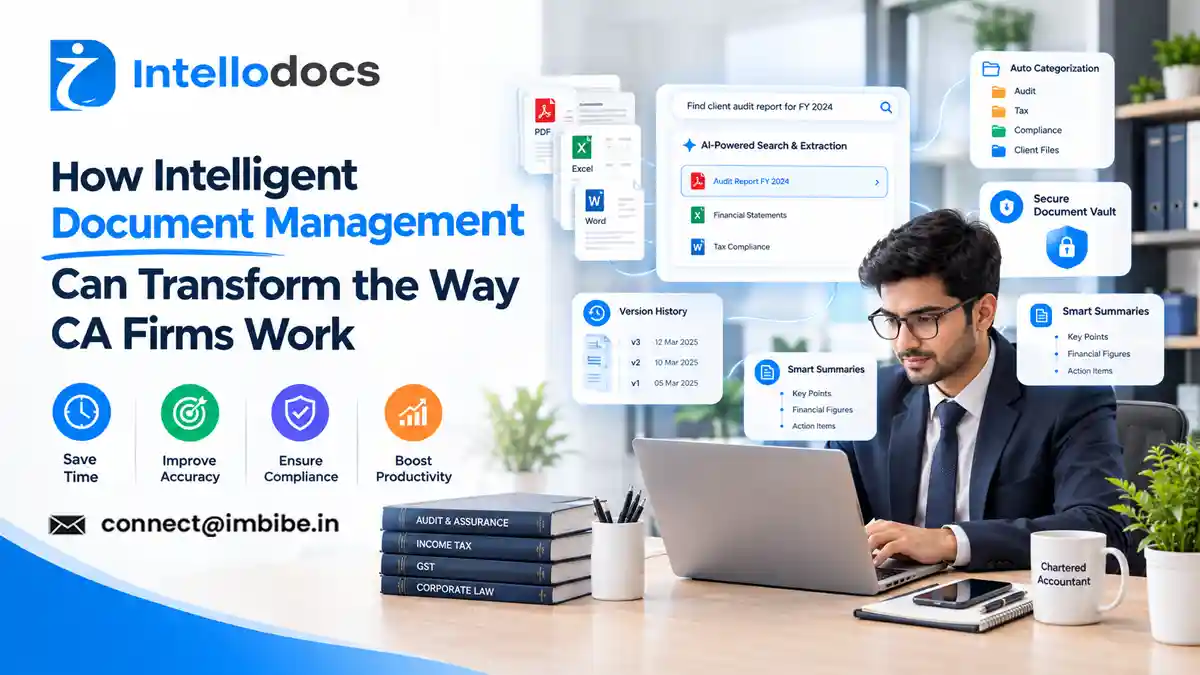
Consider the time employees waste searching for documents during a normal working day. Someone wants an old invoice, someone else is after a signed agreement and a manager is waiting for the latest version of a report. The information is there somewhere, but it takes longer to find it than it should.”
This is common in most of the businesses. As organizations grow, so does the amount of paperwork, emails, contracts, reports and internal records they need to handle. A simple folder system can quickly become a maze of duplicate files, unclear file names and outdated documents.
The issue isn’t necessarily a lack of information. Knowing where that information is, knowing if it is correct, knowing who should have access to it.
With a good document management process in place, businesses can bring their information under control, alleviating the burden of day-to-day work and decreasing the likelihood of missing key details.
Why Do Companies Need a Better Way to Manage Documents
Documents are involved in nearly every business activity. Sales teams take care of proposals and customer contracts, finance teams take care of invoices and records of payment, and HR teams take care of employee information. Departments have their own needs, but all need reliable access to the right documents.
Finding files can be a frustrating task when they are spread out over personal computers, email inboxes and shared folders. Employees may spend valuable hours asking colleagues to resend files or check whether a document has been updated. Sometimes different teams are building different versions of the same record without knowing it.
These little problems can have bigger consequences. An old contract can cause confusion, a lost approval can delay a payment, an incomplete record can create problems in an audit.
With organized document management, employees have a consistent way to store, locate, update and share business information, helping to avoid such situations.
The Everyday Problems of Disorganized Files
Poor document management doesn't always create an obvious problem right away. It complicates and slows down the everyday work more than it needs to in most cases.
Imagine a team getting ready for a client meeting. The latest proposal is in one folder, the supporting documents are attached to an email, and the current pricing sheet is on another employee’s computer. It takes a few messages and a lot of unnecessary effort to get it all sorted.
Now imagine doing this on several teams every day. Lost time looking for info, checking versions and chasing approvals can slowly chip away at productivity.
Another problem is that employees are often the only persons who know where certain records are kept. When a colleague leaves the organization or moves to another role, it can be difficult for others to find information that used to be easy to access.
A more systematized approach reduces this dependence on individual employees. It enables the right people to keep accessing business information, even when roles change.
How to Organize Documents Effectively
Good document management is not simply about putting all your files in one place. It’s about delivering data that’s easy to find, easy to use and easy to maintain.
Good organization is a good place to start. Documents should have a consistent naming and classification system so that employees can find them without having to do multiple searches. Categories may be according to clients, departments, projects or document types depending on the way the organization functions.
Version control is important as well. When a document is updated, employees should be able to see the current version, rather than relying on filenames such as “final,” “final revised” or “final latest.” Tracking changes can also help you see how a document came to be what it is.
Access permissions are important, too. Not every employee needs to see every business record. Access may be limited to financial information, employment records and confidential agreements. Correct permissions help keep sensitive information secure, while allowing employees access to the information they need to perform their jobs.
Having clear approval processes and activity records can also enhance accountability further by making it easier to know who reviewed a document and whether the required approvals were completed.
How Cloud Technology Is Changing the Way We Manage Documents
The way people work has changed a lot. Employees might be situated in different offices, working remotely, or need to collaborate with external partners. In such cases, it can be problematic if you only depend on documents saved on a particular office computer.
Authorized users can access documents through an internet connected environment using cloud -based systems. This way, teams can work on common records instead of sending the attachments back and forth, reducing the confusion of multiple copies.
For businesses seeking Cloud document management software in India, the decision is not simply about where to store files. It also includes considering how documents will be protected, who can access them, how backups are maintained and whether the system will work with existing business applications.
Security is one area that needs special focus. Businesses need to know how information is protected, how access is monitored and what happens when an employee no longer requires access. They should also consider any Indian data protection requirements that may apply to them, and any contractual commitments relating to their records.
Cloud systems may be more convenient for collaboration, but they do not offer constant access or complete security. Internet connectivity, service reliability and proper back-up arrangements are still crucial.
The real advantage is to marry the flexibility of cloud access with good information management practices.
Keeping Your Documents Organized and Audit-Ready
For many businesses, record keeping is not just a matter of convenience. Contracts, financial documents, employee records and internal approvals may be produced in the course of audits, reviews or legal proceedings.
This request can put unnecessary pressure on the person to search through disorganized folders. A consistent filing structure makes it easier to pull up documents and gives you a clearer record of what you’ve been doing in business.
Another important part of the process are retention policies. While it may seem like the safest option to keep every document forever, this can lead to clutter and more information to protect. However, deleting records before the end of the required retention period can cause serious difficulties.
Companies should make clear rules about how long to keep different records and when they can be thrown away. Access permissions should be checked from time to time, particularly if employees change role or leave.
A document management system can help with these practices, but works best when paired with clear policies and employees who know their responsibilities.
Selecting the Right Document Management Solution in India
The first step in choosing a Document management solution in India is to ask yourself a simple question: what is making document management difficult for your business today?
Some organizations have the biggest problem finding files quickly. Others have issues getting approvals, dealing with duplicate paperwork, managing access rights or keeping data consistent across departments. Knowing about these challenges reduces the features that actually matter.
It should be easy to use. If employees find a system confusing, they may continue to save documents in familiar but inconsistent ways. So, training and a practical implementation plan are as important as the technology itself.
Businesses should also examine how well a solution can accommodate growing document volumes, support existing workflows and integrate with other applications. Security, backup, technical support, and total cost of ownership should all be evaluated carefully.
What works for one organization may not work for another. The right choice is one that solves real business problems without introducing unnecessary complexity.
How to Make Document Management Work for People
Even the most perfect system depends on how people use it. Employees should know where to store documents, as well as how to name them and who is responsible for approving or updating them.
Simple rules can go a long way. And so can engaging employees in the implementation process, listening to their concerns, and making sure the new approach is a good fit with their daily work.
It is also good to check on the system from time to time. As teams expand and responsibilities evolve, you may need to adjust document categories, access permissions and retention practices.
When employees locate information without excess searching, and are assured they are working from the right version, document management becomes a real help, not just an administrative burden.
Intellodocs: Adding More Structure to Document Management
If you run a business that is looking for a more structured way to manage your information, you might want to take a look at Intellodocs as a document management platform. Organizations seeking document management solutions can learn how Intellodocs can meet their needs for document accessibility, everyday workflows and information management. As with any platform the best fit is determined by the particular needs of the organization and the capabilities it needs to support its operations.
Conclusion: Improving Findability And Usability Of All Documents
A lost file might seem like a minor inconvenience, but constant delays, out-of-date records and unclear approval procedures can impact the smooth running of a business. Over time, these problems distract from the work that really matters.
A good document management strategy means businesses can spend less time searching for information and more time using it. Organizations can build a more reliable foundation on which to operate every day by having clear processes, appropriate security and a system that suits the way people work.
If your employees are still spending too much time looking for files, checking versions or chasing approvals, it might be time to rethink the way your business manages its documents.
Get to know Intellodocs and start the shift toward a more organized way of working. Assess your document management needs today and put in place a process that helps your team find information faster, work with greater confidence, and stay prepared for the future.