

In every business paperwork is piling up somewhere. Contracts live in shared folders, invoices arrive in email, reports are saved on individual computers and important information gets lost in long files. At some stage, someone requires a particular detail and the familiar search process begins, rifling through folders, opening documents, asking colleagues, hoping the most recent version is the one you want.
Maybe it doesn't seem like a big deal at first. But when employees spend a large part of their day looking for information instead of using it, the impact adds up. Approvals get stuck, work gets duplicated and decisions take forever to make.
The bigger problem is that business documents are much more than just information to be stored. They contain information that helps teams understand customers, track commitments, identify problems and make better decisions. The challenge is knowing where to find that information and how to use it to your advantage.
That’s where document intelligence can help. It’s not only about filing away files. It's about making the information in those files more useful to the people who need them.
Why Businesses Need to Do More with Their Documents
Think of how much paperwork a business has to deal with in a week on average. There are customer agreements to review, invoices to process, employee records to maintain, reports to generate and policies to update. All departments depend on information of some kind.
It can be surprisingly hard to find the right information when documents are scattered across locations. Perhaps an employee had to open three versions of a contract before finally finding the signed copy. A manager may have to ask several people for a report that already exists somewhere within the organization.
Another risk is working with outdated information. A team may reference an old price list, fail to realize there is a new agreement, or continue to use a policy that has changed.
A lack of effort is rarely the cause of these problems. More often the information is simply not organized in an easy-to-use manner.
A better way gets employees to what they need without needless searching. It also makes it easier to know what the document is about, whether it needs to be worked on, and how it fits in with the work being done.
From Document Storage to Finding Useful Information
It is easy enough to save a document. Finding a particular detail in it months later can be another story.
Imagine a procurement manager wanting to check the payment terms agreed with a supplier. The information might be hidden in a long contract saved under an unfamiliar file name. The manager may spend a few minutes looking for the document and more time reading through it to find the relevant clause.
Now think about being able to search for that document in a more organized fashion and know where the information is in it. The same task becomes a lot easier.
This is what separates merely storing documents from managing them in a more useful way. Businesses want to be able to pull up files, know they have the right version, find what they need, not start from scratch every time.”
Good organization also makes information more useful between departments. Finance teams can find invoices, HR teams can pull policies, managers can get to reports without having to depend on the person who first made or received them.
We are not trying to add another complex process.” It is to make information easier to work with so that employees can work on their actual responsibilities.
Why It Makes Sense To Manage Documents In The Cloud
As a business grows, so does the challenge of managing documents that are stored on individual computers or in separate folders. Employees may need to work from different offices, collaborate remotely or simply need access to the same information at different times.
Cloud document management software in India can help businesses manage this challenge by providing a central place to store, organize and access documents digitally.
Instead of relying on one person to find and share a file, authorized team members can get the information they need from a shared system. This can help facilitate collaboration and reduce the back and forth that often comes with emailing attachments.
Cloud-based systems can also help with more consistent document handling. Depending on the features available, businesses could track versions, control access, search files and keep records of document-related activities.
But moving documents to the cloud is only half the answer. The same frustrations can persist in a digital environment if files are not well organized or employees cannot find the information they require.
The real value is in the mix of easy access, sensible organization, reliable search and clear rules on how documents should be managed.
How Companies Can Use AI to Understand Their Documents
Artificial intelligence is transforming the way people work with information, and business documents are no exception.
It can be a lengthy process to read through a contract to find a particular clause, to sift through a stack of invoices for information or to scan a number of reports for relevant details. AI-assisted tools can help with tasks such as classifying documents, extracting information, summarizing content and identifying relevant sections.
For example, an employee reading a supplier agreement might be looking for payment conditions or to understand the main obligations. Depending on the capabilities of the system, AI tools can surface the relevant information without the employee having to read every page.
Similarly, companies who process large volumes of invoices may be able to capture the key information more efficiently, reducing the need to repeatedly enter data.
This can make information easier to work with, but it’s important to be realistic about what artificial intelligence can actually do. A summary may leave out an important detail and information extracted may not always be accurate. Documents that are sensitive, such as contracts and financial records, may still need careful human review.
AI is most useful when it helps people find answers faster, while still allowing them to control important decisions.
Making the document work easier
One problem is to find information. Another thing is to do something with it.
A contract may require approval by several departments. An invoice may need to be verified before it can be paid. Relevant employees may need to be briefed and review a revised policy.
If these processes are based on e-mails and manual reminders, it is easy to forget what needs to happen next. Maybe someone is waiting for approval that someone else forgot to send.
A structured document workflow can help to make these responsibilities clearer. Documents can be routed through defined review stages and employees can track pending actions instead of chasing updates time and again.
For example, a purchase invoice may have a defined review process before being sent to the finance team for payment. If the contract is close to the renewal date it could be flagged for attention (assuming the system has that functionality).
Not every job has to be automated. The trick is to figure out which processes are causing delays and then streamline those processes.
Well organized documents and workflows mean less time spent on follow up and more time spent getting work done by employees.
Protecting Business Data
While it’s important to make documents easier to access, businesses need to ensure that sensitive information is protected.
Not everyone in an organization should be privy to contracts, financial statements, employee records and customer details. Access should be based on what each person is responsible for.
A solid document management process can help a business control who can view, edit, share, or approve certain files. Version histories and audit trails can also help teams understand what changed and when depending on the system.
When assessing a Document management solution in India, organizations need to consider security as well as usability and efficiency. Businesses need to know how their information is protected, how backups and recovery are handled, and whether the system supports their compliance requirements.
No technology will remove every risk. Employees need to have clear guidelines on how to handle confidential information, and access permissions should be reviewed as roles and responsibilities change.
The aim is to give the information to the people who need it, but to keep the control of that information with the organization.
The Role of IntelloDocs
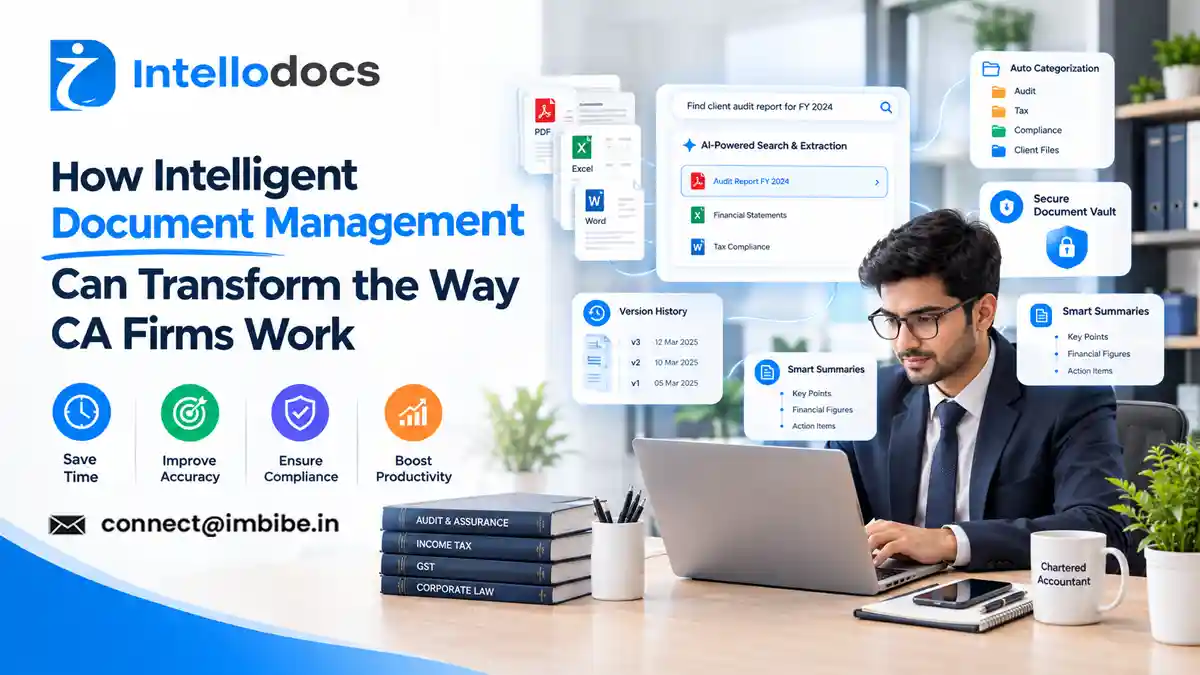
IntelloDocs is a document management platform that businesses looking for a more organized way to manage their information can explore. It offers an option to organizations who want to improve how documents are stored, accessed and handled in the course of daily work. Businesses can test IntelloDocs against their specific needs to see how its available capabilities fit into their document management processes and goals.
Conclusion: Get Your Business Documents to Work Harder
Business documents are more than just files to store and retrieve when requested. They provide teams with information to help them work more effectively, understand their responsibilities and make better-informed decisions.
That value, however, is difficult to realize when documents are scattered, old versions cause confusion and employees spend too much time searching for answers.
Better organized document management can change this. Smarter tools, the right security, easier access and better search can help businesses spend less time managing files, and more time using the information they contain.
Start by looking at the day -to -day frustrations in your organization. Looking for documents in: employees waste time What approvals are often missing? How often do teams scramble for the most up to date information? Answering these questions will help you determine the area where a better approach would make the most difference.
Ready to turn your enterprise documents into useful insights? Discover IntelloDocs and how a more structured approach to document management can help your team locate information more easily, streamline everyday processes and make better informed decisions. Go one step further to make your business information truly useful.